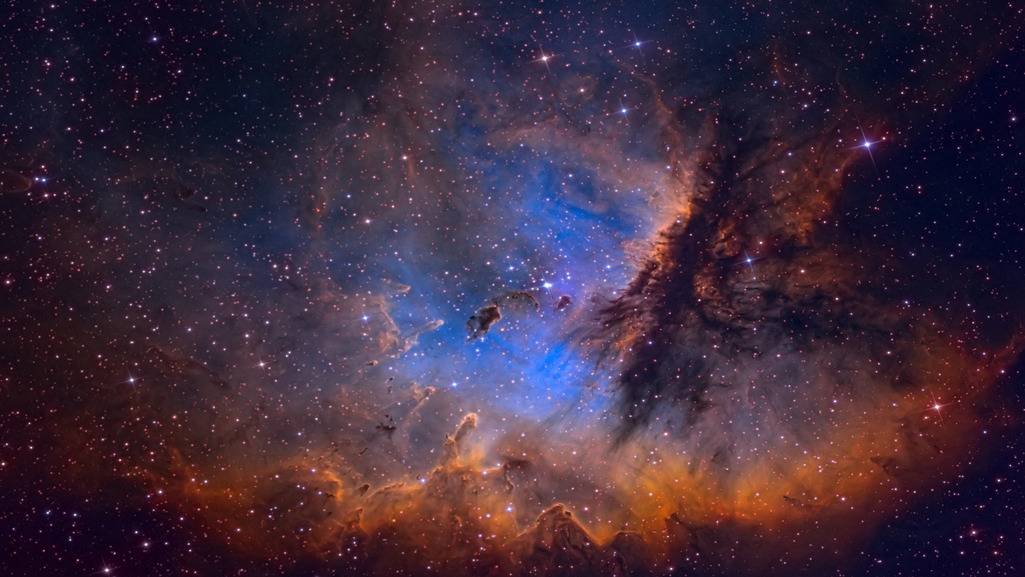
A fleeting visitor from the edge of time, glowing softly to remind us how ancient the universe truly is.
A celestial riddle once said, “A fleeting visitor from the edge of time, glowing softly to remind us how ancient the universe truly is.”
This perfectly describes one of the most remarkable astronomical events of 2025 — the appearance of Comet Lemmon (C/2025 A6).
A comet is a small icy body that orbits the Sun, often referred to as a “dirty snowball in space.” It is composed of frozen gases such as water, carbon dioxide, and carbon monoxide, mixed with dust, rock, and organic molecules — the same building blocks that once contributed to the origin of life on Earth. When a comet approaches the Sun, solar heat causes these ices to sublimate, releasing gas and dust that form a bright coma and a long tail that always points away from the Sun due to the pressure of the solar wind.
Comet Lemmon was discovered on January 3, 2025, by astronomers at the Mount Lemmon Survey in Arizona. This green-hued comet is making its first close journey near Earth in over a thousand years. Classified as a long-period comet, it takes more than a millennium to complete a single orbit around the Sun. In October 2025, it made its closest approach to Earth at a distance of about 90 million kilometres, and it will reach its perihelion — the point nearest to the Sun — on November 8, 2025.
The comet’s distinct green glow arises from the presence of molecules such as diatomic carbon (C₂) and cyanogen (CN), which emit green light when energized by sunlight. Occasionally, interactions with intense solar wind can even detach portions of its tail — a fascinating display of the Sun’s influence on celestial bodies.
Comet Lemmon serves as a scientific treasure, preserving material from the early solar system. Studying its composition helps researchers understand the processes that shaped the planets and the potential role of comets in delivering organic compounds essential for life. For observers across India and the Northern Hemisphere, this rare phenomenon offers a remarkable opportunity to witness a visitor that will not return for another thousand years — a true reminder of the vastness and continuity of our universe.