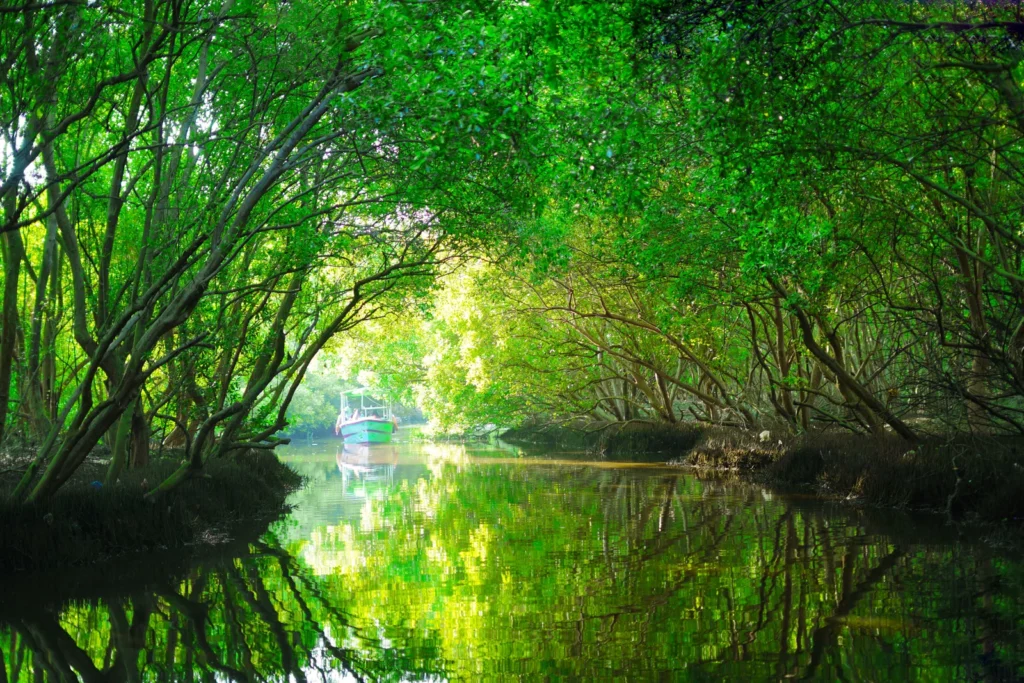
In the quite corners where the land dissolves into the sea, Puducherry hides its most precious stones. These are not mined from the earth, nor are they polished by human hands. These are the Mangroves, the living emeralds of the Coromandel coast. The mangrove wetlands primarily centered around the Thengaithittu estuary, Ariyankuppam river and Gingee river are a testament to nature’s ability to create beauty out of resilience.
Mangroves are salt-tolerant forest ecosystems of tropical and subtropical inter-tidal regions of the world. Mangrove swamps are complex ecosystems and ecotones between land and sea. This environment is characterized by high salinity, low oxygen and muddy terrain subject to tidal action.
Mangroves have an ability to live in salt waters and are quite stable under varied physical and chemical conditions. The soil in mangrove forests is typically waterlogged, unstable, and lacks oxygen. Mangroves have evolved specialized root systems to cope up with these conditions. These include the Pneumatophores (or breathing roots), Stilt roots, Buttress and Knee roots. To cope with high salt levels in the brackish water, they excrete excess salts through salt glands present on their leaves. Reproducing in tidal water is risky; seeds falling into the water might rot or wash away. Mangroves exhibit vivipary- a condition where the seed germinates while still attached to the parent tree.
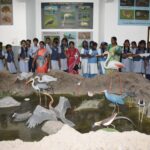
At taxonomic level, the biodiversity of Pondicherry mangrove system includes both the diverse flora and fauna. This region is a breeding ground for aquafauna and avifauna. The region has 10 natural mangrove species and 6 species that were introduced under social forestry scheme by Agriculture dept.
There are 15 species of molluscs identified in this region and of these two clams (Meretrix casta) and green mussels (Perna viridis) are abundant near the mouth of estuary and collected in large quantity for their meat by the local population. 15 species of crustaceans, 39 species of fishes and over 80 species of birds are also identified.
The biggest threat for Puducherry Mangroves is the untreated sewage that is allowed to flow directly into the lagoon. This effluents containing heavy metals and agricultural pesticides and these toxins accumulate in the sediment. Floating plastic waste and debris trapped in these roots chokes the mangroves. Motor boats pose a threat through physical erosion, root undercutting, leaking fuel and lubricants. Tourism would be most welcome and yachts and kayaking would be a better choice for sustainable ecotourism.
These forests are the Green walls of Puducherry. When the ocean roars, the mangroves stand firm. Their tangled root systems dissipate the energy of waves and cyclones, protecting the land behind them. They trap sediments, filtering the water and preventing erosion, ensuring that the coastline remains intact for generations to come. They play a vital role in carbon fixation. They store 10 times more carbon than terrestrial plants. The mangroves are the silent guardians, the breathing jewels that adorn the neck of the coast. They remind us that true treasure is not gold or silver , but the vibrant , pulsating web of life that sustain us. Conservation efforts are need of the hour to protect this precious biodiversity.