Hey! Have you heard about the glowing beach incident in Chennai and Puducherry? Now you have heard about it: On 21st October 2024 the beaches in Chennai and Puducherry witnessed glowing waves. Not only in Chennai and Puducherry, in many places all around the world we see water bodies glowing on occasion or on most nights.
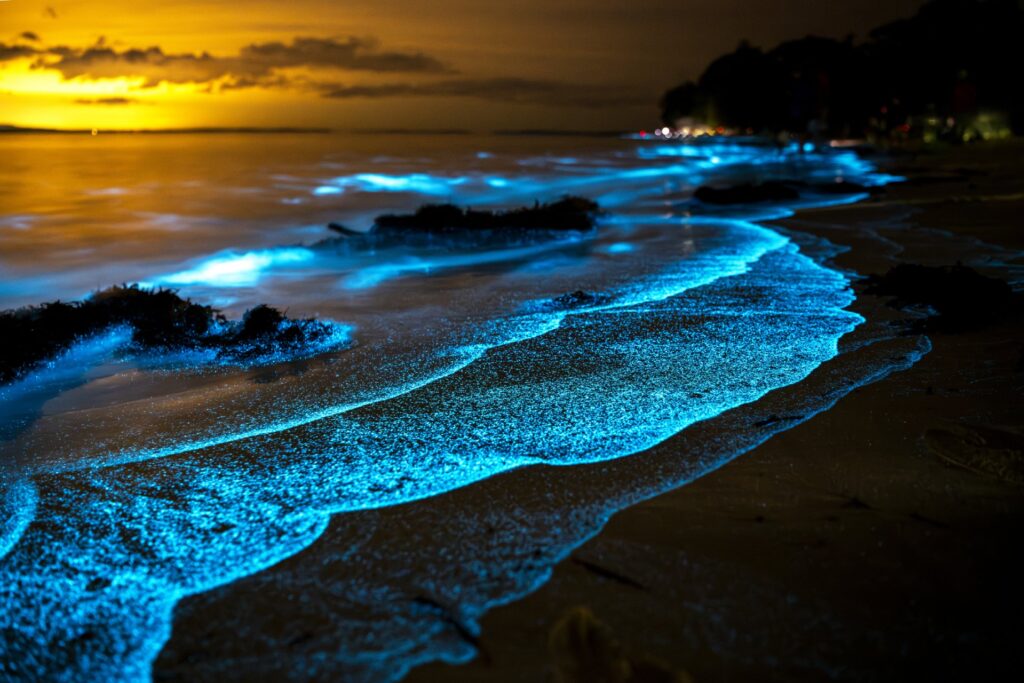
The Glowing of the oceans and seas is due to the organisms mainly bacteria that exhibit glow- a property called- Bioluminescence.
But why and how?
We do not know why with certainity. It could help these organisms locate food, or attract prey or mates?.
To the second question how, it’s just a simple answer that they undergo a chemical reaction that helps them to produce light. The process of bioluminescence is triggered by a chemical reaction involving two distinct compounds: luciferin and either luciferase or photoprotein. The enzyme responsible for facilitating bioluminescent reactions is known as luciferase. The various substrates utilized in these reactions are referred to as luciferins. Luciferase catalyzes the chemical reaction between luciferins and oxygen, leading to the oxidation of the luciferin molecule, which produces light. After the reaction, luciferase is recycled, allowing for continual light production in the presence of both luciferin and oxygen. he specific color of bioluminescence yellow in fireflies and greenish in lanternfish results from the structural arrangement of luciferin molecules.
This biochemical reaction can occur within an organism or in the surrounding water; for instance, in bioluminescent shrimp that emit light externally, the reaction occurs outside the organism, whereas, in other species, it transpires within the cells, or in some cases, it is facilitated by bacteria residing in the organism.
Certain bioluminescent organisms, such as dinoflagellates, are capable of synthesizing luciferin independently, resulting in a bluish-green light. These dinoflagellates belong to a category of planktonic marine organisms that can cause a sparkling effect on the surface of the ocean at night. Conversely, some bioluminescent organisms do not produce luciferin on their own but rather acquire it from other organisms through consumption or symbiotic relationships. For example, some species of midshipman fish derive luciferin from the “seed shrimp” they ingest. Moreover, numerous marine animals, including certain squid, host bioluminescent bacteria within their light organs, establishing a symbiotic relationship.
Most bioluminescent reactions are characterized by the interaction of luciferin and luciferase; however, there are exceptions where a chemical known as a photoprotein, is used instead of luciferin.
Light emission of Bioluminescent organisms
The manifestation of bioluminescent light exhibits considerable variation, influenced by the habitat and the specific organism involved. Most marine bioluminescence, for instance, is expressed in the blue-green part of the visible light spectrum. These colors are more easily visible in the deep ocean. Also, most marine organisms are sensitive only to blue-green colors. They are physically unable to process yellow, red, or violet colors.
Similarly, a number of terrestrial organisms also display blue-green bioluminescence. However, several species, including fireflies and the bioluminescent land snail Quantula striata, which is endemic to the tropical regions of Southeast Asia, exhibit luminescence in the yellow spectrum. A limited number of organisms are capable of emitting light in multiple colors. Among the more recognizable is the railroad worm, which is actually the larva of a beetle; this organism features a red glow at its head while its body emits green light. The variations in bioluminescence are attributed to different luciferases present within these organisms.
In conclusion, the phenomenon of bioluminescence stands as a testament to the remarkable power of chemistry in the natural world. At its core, bioluminescence is the result of complex biochemical reactions involving luciferins, luciferases, and oxygen, a process finely tuned over millions of years of evolution.