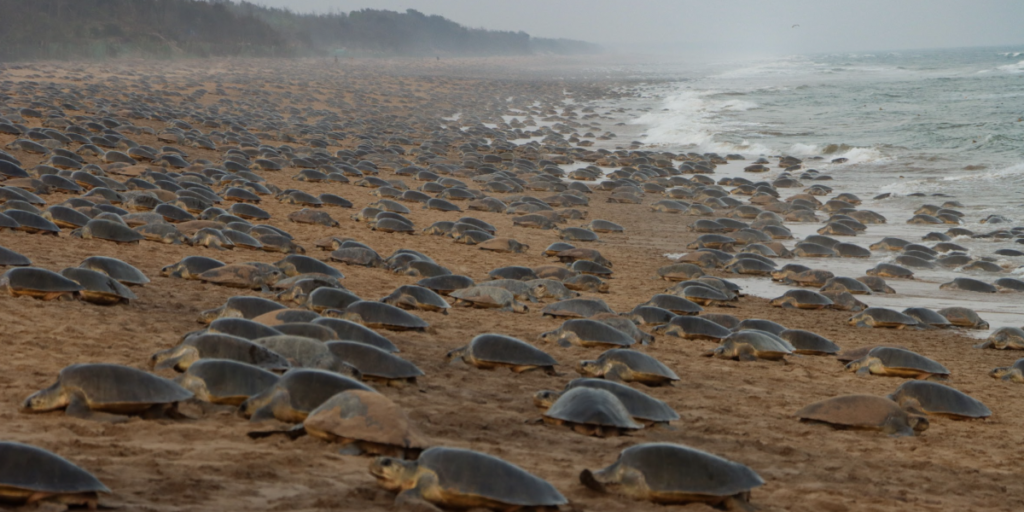
For nature-lovers and conservationists, there is cause for celebration. This year, Odisha witnessed a record mass nestling of 6.5 to 7 lakhs turtles arriving at the Rushikulya rookery, a significant success for conservation efforts. This mass nesting is called the Arribada. So, what is the Arribada?
“In every slow paddle, the turtle writes resilience upon the water “ – this is a great saying on one of nature’s marvellous creatures. As dusk descends over Bay of Bengal, millions of Olive ridley turtle hatchlings , erupt from the sand, and guided by the moon light, make a frantic, tiny –flippered dash for the waves. This is one of the most spectacular natural phenomenon. And before this journey of tiny hatchings towards the sea, there is reunion of hundreds of thousands of mother olive ridleys along the shore , which emerges from the surf simultaneously. The Arribada is a marvellous biological event. It begins with the arrival of mother sea turtles, from thousands of miles apart, and they navigate to the exact beach, where they born. They don’t just arrive, they wait off the Eastern coast of India; gathering in shallows, waiting for the perfect time. Triggered by several environmental and biological factors such as the lunar phase, tidal cycles, temperature, rainfall and pheromones, when the moment is right, they swarm in. The oceans seem to be filled with olive green shells, and the beach sand appears replaced by a moving pavement of mother turtles. For a few nights, the beach belongs to this tiny sea creatures for mass nesting.
Sea turtles of the genus Lepidochelys olivaceae (Olive ridley turtle) take part in synchronised nesting events, known as arribadas, where a large number of females emerge simultaneously from the sea to nest on the beach. The specific coastal area, like a beach or river mouth, that serves as a major breeding and nesting ground is called as sea turtle rookery. Reproductive synchrony is a strategy where individuals carry out parts of their reproductive cycle at the same time as other members of the population. This strategy is widely observed across the plant and animal kingdoms, such as blooming of Rhododendrons, flowering of bamboo, the emergence of cicadas, synchronised spawning in several aquatic insects, corals and fish. Studies suggest that breeding or reproductive synchrony serves as the anti-predator strategy and increases the chance of finding a mate. Olive ridley turtles are one of two ridley species which exhibit the arribada phenomena. Although olive ridley turtles participate in solitary nesting as well as known for their arribadas which occur primarily on a few beaches in Central America and India. The turtles mate in offshore waters during the breeding season, from October to February.
Currently, there are two mass nesting sites on the east coast of India in Odisha, at Gahrimatha and Rushikulya.The Rushikulya nesting site is located on the southern coast of the Indian state of Odisha, at the mouth of the Rushikulya river. Mass nesting mostly occurs on a 4 km beach stetch that extends north of the river mouth or sometimes on a sand spit that forms in front of the nesting beach . The Gharimatha mass nesting beach, located about 250km north to Rushikulya, is at the mouth of the Brahmani and Baitarani rivers and it is part of Bhitarkanika National Park. Nesting used to occur on a 10 km stretch on the mainland beach. And it is the world largest sea turtle roorkery for Olive ridleys
Thirty-nine arribadas occur in Gahirmatha between 1978 and 2020. Arribadas did not occur in 1988, 1992,, 1997, 2002 and 2004. There have been 23 arribadas in Rushkulya between its discovery in 1994 and 2020 with arrribadas not occurring in 1999, 2000, 2002, 2007 2016 and 2019. Mass nesting in Gahirmatha has ranged between 1 lakh to 8 lakh in different years, and in this year, 2025, it was the largest.
Olive ridley turtles nest along the Coromandel Coast and are known to forage in southern Tamil Nadu waters. One major site is the beaches of Chennai, especially south of the Adyar river. Another is the Cuddalore district coast including some sites in Puducherry. There are four other species of turtles that appear in this coast- but nesting by other species is rare if present at all. Since numbers of turtles in this coast are less, there is an effort made to collect the hatchlings, help them grown in over 60 nurseries established along the coast and then release them into the waters. Volunteers undertake regular turtle walks in the night between January and March to help with this. Reports show that such conservation is helping and nesting along this coast is also increasing.