Table of Contents:
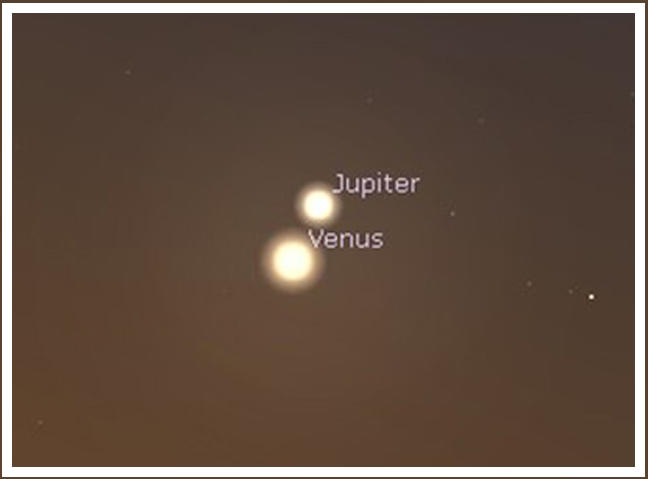 Starting off this month’s celestial highlights are two of the brightest planets in our night sky, coming close together, often termed as a ‘cosmic kiss’ (not literally though!). Venus and Jupiter appear to draw closer in the night sky over several weeks, up until their closest encounter on 9th of June.
Shortly after sunset, look just above the western horizon and you can spot this bright pair. Since they set real soon after sunset, you can only observe them for a brief period of time. On this day, Venus and Jupiter will appear separated by just 1.6 degrees in the night sky, easily fitting within the same binocular field of view. You can track their path with each passing day before and after the conjunction, and you can notice their changing positions.
Are they actually close together during the event? No. They only “appear” to be close from our point of view on Earth, while in reality they still remain hundreds of millions of kilometers apart. It is the orbital motions of both the planets and our Earth which create this dazzling sight.
Moreover, Jupiter will soon disappear from our view in the night sky, eventually to appear only in the morning by mid-June, making it harder to see due to our all-bright Sun. This makes this conjunction one of the last good opportunities to catch the gas giant, before it is lost into the solar glare.
Did you know that the distance between Earth and the Moon is not always the same? It would be the same if the Moon’s orbit is a perfect circle. However, it is slightly elliptical, which means, sometimes the Moon is a little closer to Earth (called ‘perigee’) and sometimes it is slightly farther away (called ‘apogee’).
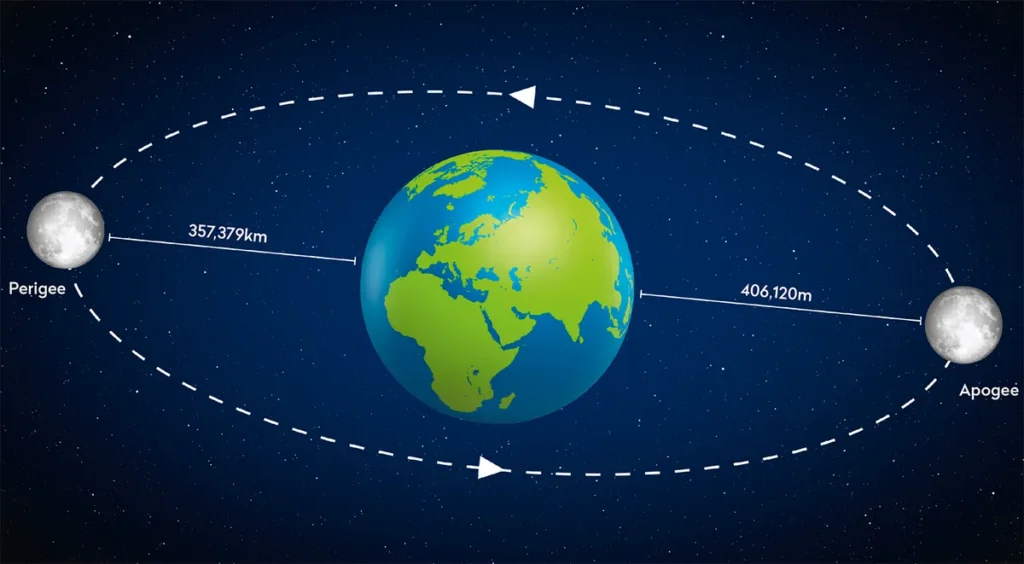 As a result, the Moon appears slightly larger in the sky at perigee and slightly smaller at apogee, even though its actual size never changes. It is simply the changing distance between Earth and the Moon that causes this difference in apparent size.
During every 27-day orbit around Earth, the Moon passes through both perigee and apogee. Meanwhile, over a cycle of about 29.5 days, we get from the new Moon to the full Moon and back again. When a new Moon occurs close to the time of perigee (when the Moon is closest to Earth), it is commonly called a Super-New-Moon (although, this is not an official astronomical term).
This month you can witness it on June 15 in the night sky, where the Super-New-Moon is completely invisible to the naked eye. This is because the Moon is at such an angle that its illuminated side is completely facing away from us. Because the Moon is physically closer to Earth than usual, its gravitational pull is stronger, leading to a slight increase in the range of high and low tides, known as ‘perigean spring tides’.
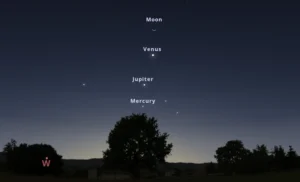 We previously witnessed Venus and Jupiter shining close together in the night sky. Now, a third planet is about to join the cosmic fun. The so-called “Swift planet”, Mercury is all set to align with Venus and Jupiter to form a striking line in the night sky. What makes this even more exciting is that the crescent Moon will also join the trio and extend this alignment.
You can witness this beautiful sight, from around June 12 to June 18, by looking towards the west after sunset. You can also watch the Moon gradually aligning with the other three over these days. Since Mercury will sit lower towards the horizon, you will need a clear and unobstructed view to the west to catch it in the glow of twilight.
Although we don’t use the term ‘planet parade’ in official astronomical terms, people commonly refer to this when several planets align in the night sky. Even though we call it ‘aligned’, it only appears to do so, when we see it from the Earth. They remain separated by vast distances throughout the Solar System, often by hundreds of millions or even billions of kilometres.
Ever felt like you had a really long day or an unusually short one? Well, they actually might be. It happens that, due to Earth’s axis tilt of 23.5 degrees, the lengths of our days and nights are not constant throughout the year. The Sun’s path across the sky and the location of the sunrise and sunset along their horizons, all gradually shift as Earth revolves around the Sun.
A solstice marks one of the two extreme points in the Sun’s apparent journey across our sky. Solstices occur twice yearly, once in June (on 21st this year) and once in December (on 21st this year). During the June solstice, the Sun reaches its northernmost position relative to Earth’s equator, while during the December solstice, it reaches its southernmost position.
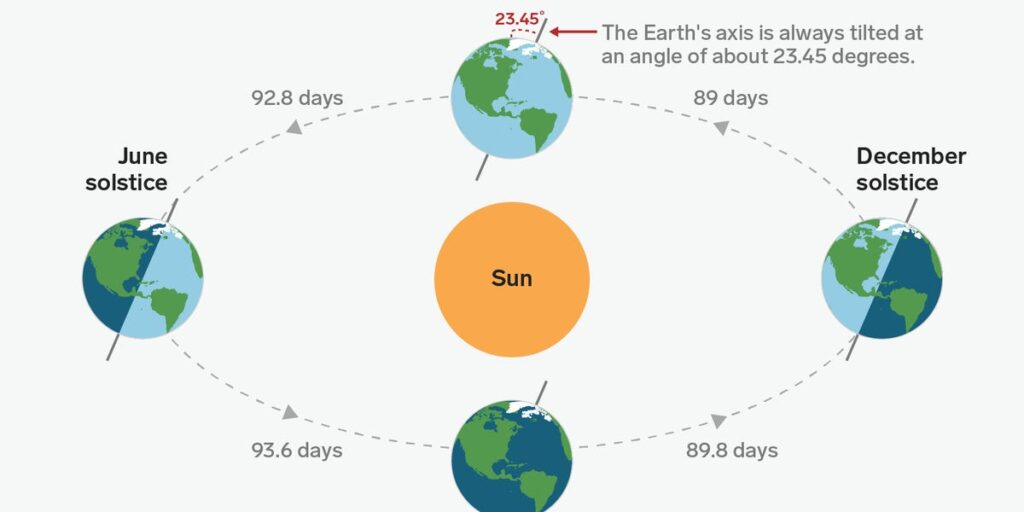
At the June solstice, the Northern Hemisphere is most tilted toward the sun, by the maximum angle of 23.5 degrees. Conversely, the south is most tilted away, by the same amount. For us in the Northern Hemisphere, we get to experience the shortest night and longest day of the year. For those in the Southern Hemisphere, it marks the longest night and shortest day.
After this, the Sun will begin to shift southward in our sky again. Such apparent changes in the position of the Sun is also related to the interesting phenomenon of ‘Zero Shadow Day’, observed in parts of India. But why does this occur only in the lower half of India, and how is it related to the Sun’s changing position? Try to find out!
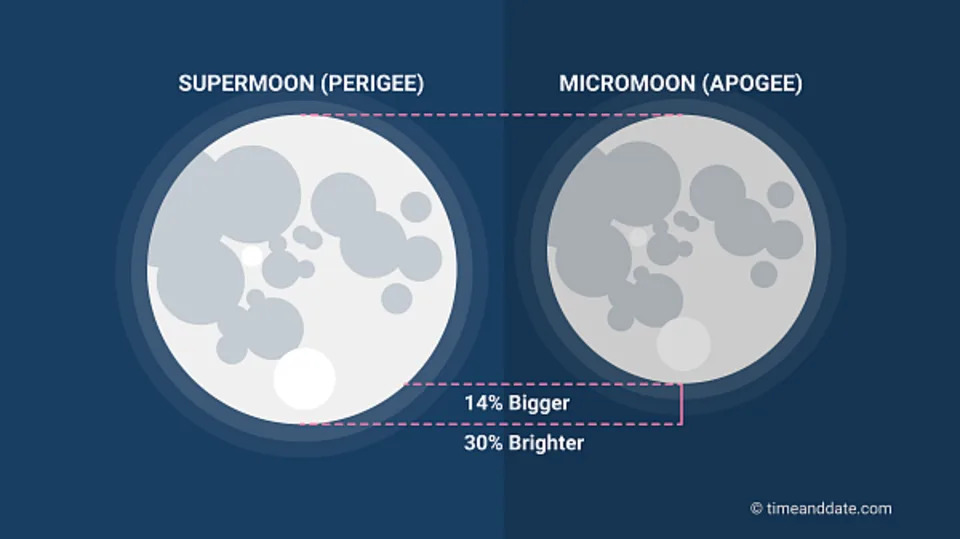 We saw earlier that the Moon has two specific positions, perigee and apogee and it reaches these two twice in a 27 day cycle. While the Super New Moon occurred near perigee, this event takes place in its farthest point, the apogee.
The Moon reaches apogee on 28 June and this closely coincides with the full Moon appearing on 29 June. This is the opposite of a ‘supermoon’, known as ‘micromoon’, and appears smaller and dimmer than usual in the night sky. A full Moon occurs when the Moon is positioned roughly opposite the Sun.
The term ‘Strawberry Moon’ does not mean that the Moon appears in red or pink colour like a strawberry. This is rather a traditional name originating from North America associated with seasonal harvests of wild strawberries in June.
Although the difference in size is difficult to notice with the naked eye, the Strawberry Micromoon provides an excellent opportunity to appreciate how the Moon’s changing distance from Earth subtly affects its appearance in our sky.